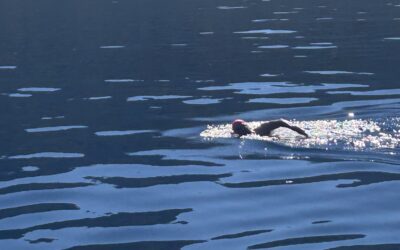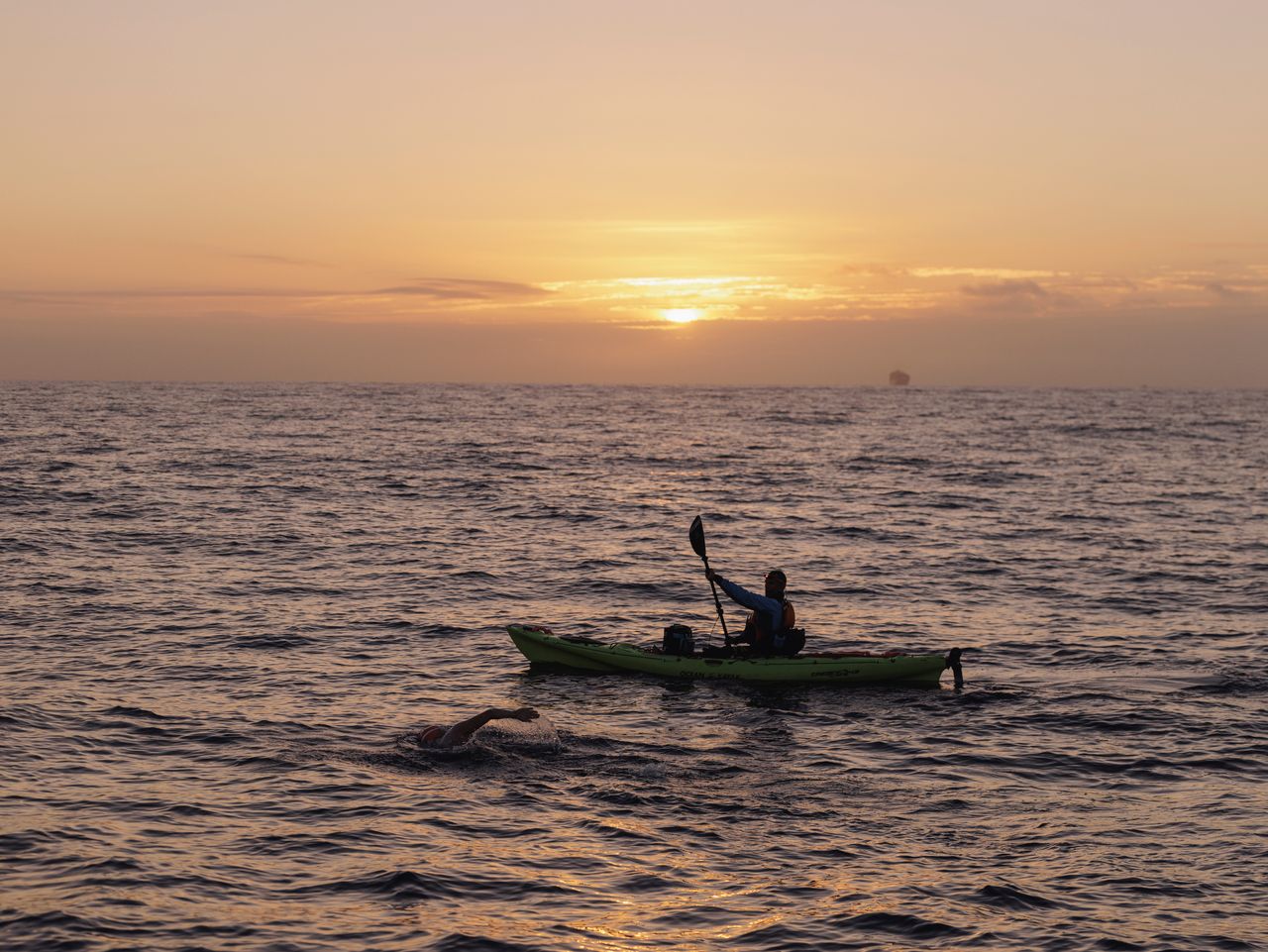

About three hours into my swim, I noticed something below me. A dark shape in the water, moving when I moved, following me. A full moon was shining brightly down on me, and I could see the stars glittering in the night sky as I breathed left and right. I’m six miles off the coast of Catalina, it’s 2am, and my mind went exactly where you’d expect, there’s a big fish down there!
It took me longer than it should have to figure out what I was looking at was my shadow staring back at me deep in the water below. The thing following me was me! In my last swim post, I shared my length of Lake Tahoe experience, a 13-and-a-half-hour swim that humbled me. I closed by saying I’d be back on the west coast in eight weeks to attempt another big swim. This was it: the Catalina Channel, 31.36 km (about 19.5 miles) from Doctor’s Cove on Catalina Island to Smuggler’s Cove on the California mainland. I finished in 11 hours and 35 minutes. Here are five things the channel taught me.
1. Rest Is Part of the Plan
My crew and I met at the marina around 7pm on a Sunday evening. We connected with the boat pilots, boat crew, the observers who would officiate my swim, and my two kayakers who would take turns paddling for me. After our safety briefing on the boat, we began motoring towards Catalina over the next two hours.
My head crewperson briefed the kayakers and observers on my feeding plan, kayaker support, and other logistics. My support boat was a large dive boat with 20 bunk beds below deck. So, once all the information was shared and questions answered, I did the most productive thing I could think of. I crawled into a bunk and tried to sleep.
It’s tempting before something big to stay busy. Check the gear again, run through the plan one more time. But the training was done. What my body and brain needed was rest. Most of us treat rest as a reward after doing the work. Sometimes rest is the work.
2. Not Every Shadow Is a Shark
Back to that shadow. In the dark, earplugs in and face in the water, there’s no one to talk to. It would be easy for my brain to fill the gap with the scariest explanation available. Once I understood what I was seeing, there was no need for fear, my shadow became company for the rest of the night.
A lot of what we fear works the same way. The unknown feels threatening until we take a closer look. Often the thing that scares us most is our own imagination. I prepared for this swim just as much mentally as I did physically. Attempting to remain stoic is not natural. Our brain loves to react into fear mode, it takes daily practice to override this bad habit.
3. Consistency Beats Intensity
For the full 11 hours and 35 minutes, I held my stroke rate at 60 to 62 strokes per minute. No surges, no fading. That’s more than 40,000 strokes, each one about the same as the last. There’s nothing dramatic about it, and that’s the point.
After roughly six hours of swimming in the dark, the sky started to brighten around 5:30 or 6 a.m. As the light came up, so did my energy, and I was able to finish strong. But the sunrise only helped because I’d kept a steady pace through the night. The boring, repeatable effort is what got me to the part where things felt good again.
4. Small Fixes Add Up
Tahoe taught me a hard lesson about nutrition; it must work so I may work. I came to Catalina with a new nutrition plan and a new feeding system. My liquid feeds took under 30 seconds; I alternated every thirty minutes between water & Liquid IV and my carb mix. Every two hours I added a purée packed with 5 grams of protein and washed it down with some water. These feeds stretched to about a minute.
My practice paid off and everything, updated gear and food, worked fantastically. The boat crew and observers told me some swimmers stop for five minutes at each feed, which adds a lot of time over a long swim. Shaving minutes off at each stop doesn’t feel like much in the moment, but over a night of feeds, it compounds.
5. Don’t look up, head down
Entering and exiting the shipping channel I saw enormous container ships leaving Long Beach. The swells had picked up as I got closer to land. Dolphines were spotted just ahead, but as I arrived, they had moved elsewhere. This is where it’s really tempting to look up and ask yourself “are we there yet?” No, we weren’t but, I tried to keep my head down, but couldn’t resist looking up, when will land get closer? And then, just like that it did. It was a wavy finish as the surf break was enormous. Getting onto the beach clearing the wet sand took everything I had left. Then the boat honked its horn to make it official: swim complete!
And then I realized I still had to get back. Exhausted, I turned around, went back out through the break toward my kayaker, and swam to the boat. Nobody puts that part on the poster.
Reaching a big goal rarely means the work is over. Whether it’s a finish line, a retirement date, or a kid heading off to college, there’s always a next stretch of water, so it helps to save a little energy.
It Takes a Crew
A swim like this is never a solo effort. A big thank you to the two captains on the Pacific Star and their boat crew in plotting a straight course. I must thank my observers for making my swim official and my two kayakers, Michelle and John. Head crewperson Carol made all the details sync to set up a seamless swim. Crew number two, Jason captured the energy in still photos memorializing this event forever. Everyone’s support all night and morning long made the difference, I am grateful!
Catalina was my answer to Tahoe. Next up is the English Channel from Dover to France in September 2028, so stay tuned. I’ll be mapping out some other swims in 2027 to better prepare for salty cool water temps.
So, here’s my question for you: what’s your “Catalina”? And is something in the water below you really a shark, or just your own shadow?